
The porphyria attacks that stomp on my ‘cute inner mitten’
Attacks may come and go, but the impact of my symptoms gets worse
Written by |




Fezzy Wezzy is a cute little kitten. Fezzy Wezzy is as soft as a mitten. Festus’ claws, however, will tear you to shreds.

Festus “Fezzy Wezzy” naps with his paw in his owner’s palm. (Photo by Kalyn Shelton)
One-year-old Festus “Fezzy Wezzy” is as soft as a brand-new pair of winter mittens, but he is also vicious and his sharp claws require frequent trimming. Several times, he has drawn blood just by barely latching on during playtime.
I understand now that just because something is “cute” doesn’t mean it cannot hurt you. Take acute intermittent porphyria (AIP), for example.
I’ve written previously that porphyria brought fear into my life. As I thought about how I broke down the word “porphyria” (pohr-fear-ee-uh) in a way I could relate to, I realized I left out “acute intermittent.”
At first glance, the words don’t sound so bad — “acute” can mean small (in reference to an angle), and “intermittent” refers to something that comes and goes. I can fully picture what my body goes through during an AIP attack when I envision “acute intermittent” as “a cute inner mitten” in my liver that’s on fire and being stomped on.
If you’ve ever experienced AIP symptoms, you’re fully aware that while they may ease up or go away at times, their impact is far from small.

AIP symptoms don’t just come and go
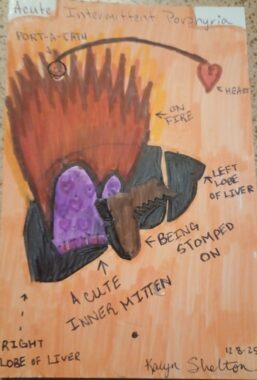
Kalyn Shelton drew an illustration of a fuzzy mitten being set ablaze and stomped on inside the liver to describe the pain of an acute intermittent porphyria attack. (Photo by Kalyn Shelton)
Symptoms can vary among patients, but for me, they include anxiety, depression, mood swings, brain fog, extreme changes in blood sugar levels, nausea, vomiting, and pain throughout my body.
This pain, along with pseudo-seizures and extreme confusion, occurs during attacks that typically result in me being hospitalized. During an attack, Panhematin (hemin for injection), dextrose, and pain medicine are administered until the symptoms become more manageable.
When I was diagnosed with AIP in October 2020, I was very weak. Still, I felt as though I would bounce back fairly quickly between attacks, but the more attacks I had, the harder it became to recover like I’d once been able to.
I went almost two and a half years without being hospitalized due to an attack, but I continue to feel its effects every day.
I am no longer able to do the things I used to enjoy doing, such as weeding, walking and riding around, and caring for and spending time with people. I don’t have the energy.
I am good company for maybe an hour, and then I want to rest. I can’t stand for longer than five to 10 minutes without burning pain in my legs and ankles.
For now, all I want to do is get back to my kitten that is softer than the fiery, stomped-on mitten in my abdomen that’s causing so much fear. Despite the scars left from my daily battle with AIP, I remain a beyond-blessed porphyria warrior!
Note: Porphyria News is strictly a news and information website about the disease. It does not provide medical advice, diagnosis, or treatment. This content is not intended to be a substitute for professional medical advice, diagnosis, or treatment. Always seek the advice of your physician or other qualified health provider with any questions you may have regarding a medical condition. Never disregard professional medical advice or delay in seeking it because of something you have read on this website. The opinions expressed in this column are not those of Porphyria News or its parent company, Bionews, and are intended to spark discussion about issues pertaining to porphyria.


Gail Horst
Im in the final stages of writing my own testimony slash guidance and informational book about my long time misdiagnosed journey with AIP/PCT ( ya, you read that right, I'm hit with a double whammy). It's as if after reading yours that, almost verbatim, I copied yours and wrote it down ( not actually, but oh so similar). With the exception of the fact that my symptoms are chronic, with no breaks. I was nodding my head yes, yes , I get that, at your every struggle filled symptom. I kind of did the same with my Doctor, as upon diagnosis, he began to read off related symptoms. I was kind of being put at ease as he explained. Not that I'd ever be OK with myself, or any one else having this life crusher; however, after 14 yrs. of misdiagnosis- and being told it's in my head, and test after test from ahlzhiemers to what ever disease that begins with the letter "Z".
.....Finally being told in exact explanation of every symptom as if he'd suffered with me all these years. It was actually a relieving bitter sweet historical marker in my life!
I mainly am writing to say that you're in my special, daily prayer list. I can relate, and while I hate that you and any others must suffer this way, for what it's worth- you're not alone or isolated.
May this find you in a God sent remission!!
Respectfully,
Mr. G. Horst Jr.